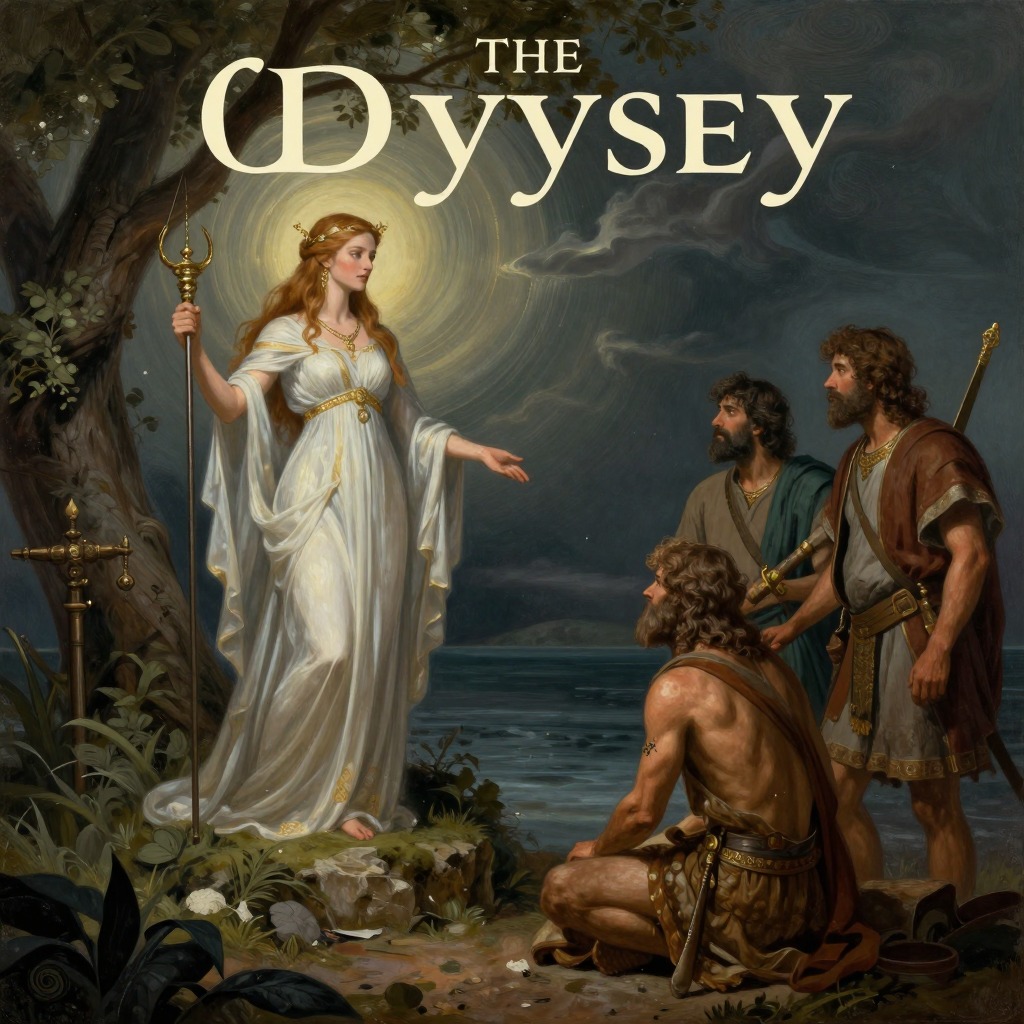
Elpenor
Elpenor is the youngest and least remarkable of Odysseus's companions, a figure whose brief appearance in the Odyssey serves as a poignant reminder of the fragility of human life and the sacred duty of burial. He is defined not by martial prowess or cunning but by a foolish, drunken accident that costs him his life, and his ghost's plea to Odysseus elevates him from a forgotten casualty to a catalyst for one of the poem's most solemn rituals. His story, though small in scale, resonates with the epic's larger concerns: the proper treatment of the dead, the randomness of fate, and the contrast between the glory sought by heroes and the inglorious end that awaits the careless.
Identity and Character
Elpenor is introduced as "a certain youth" who was "not very remarkable for sense or courage." He is the youngest member of Odysseus's crew, a detail that sets him apart from the more seasoned warriors who survived the Trojan War. His defining trait is a lack of foresight and self-control, which leads directly to his demise. While the other men are described in terms of their loyalty or their skills in battle, Elpenor is characterized by his vulnerability to the temptations of wine and his poor judgment. He is, in essence, an ordinary man caught in extraordinary circumstances, and his ordinariness makes his fate all the more affecting.
Death on Circe's Island
Elpenor meets his end on the Aeaean island, the home of the enchantress Circe. After a year of feasting and ease, Odysseus's men are preparing to depart for the underworld as Circe has commanded. Elpenor, having drunk heavily, had climbed onto the roof of Circe's house to sleep off his intoxication in the cool night air. When he heard the bustle of the men preparing to leave, he "jumped up on a sudden and forgot all about coming down by the main staircase, so he tumbled right off the roof and broke his neck." His death is instantaneous and utterly without dignity. He is not killed by a monster or in battle but by his own drunken carelessness. The crew, in their haste and distress, leave his body behind, unwaked and unburied, as they set sail for the realm of Hades.
The Ghost's Plea in the Underworld
When Odysseus performs the necromantic rites at the edge of the underworld, the first ghost to approach the trench of blood is that of Elpenor. Odysseus is surprised to see him, noting that he had arrived "on foot quicker than I have with my ship." Elpenor's ghost is in anguish, not from any torment of the afterlife, but because his body lies unburied. He begs Odysseus, "by your wife, by the father who brought you up when you were a child, and by Telemachus," to return to Circe's island and perform the proper funeral rites. He asks specifically to be burned with his armor, to have a barrow raised for him on the seashore so that future generations may know his story, and to have the oar he used in life planted upon his grave. Odysseus, moved by the plea, promises to fulfill his request. This encounter establishes a crucial moral obligation: even the most insignificant of the dead must be honored, and a leader is responsible for the proper care of all his men, not just the heroic ones.
Funeral and Significance
After Odysseus and his men return from the underworld, they fulfill their promise to Elpenor. They cut firewood, weep over his body, and perform his funeral rites. His body and armor are burned to ashes, a cairn is raised, and a stone is set upon it. At the top of the cairn, they fix the oar he had used to row with, a simple but powerful marker of his identity as a sailor. This act of burial is the final, proper conclusion to Elpenor's story. It provides closure for the crew and satisfies the demands of piety. Elpenor's role in the epic is thus complete: he is a figure who, through his own folly, dies an unheroic death, but whose ghost's demand for proper rites reinforces one of the poem's central ethical principles—that the living owe a sacred duty to the dead, regardless of the manner of their passing. His story serves as a counterpoint to the grand narratives of heroes like Achilles and Agamemnon, reminding the audience that even the most ordinary life deserves to be remembered and mourned.